
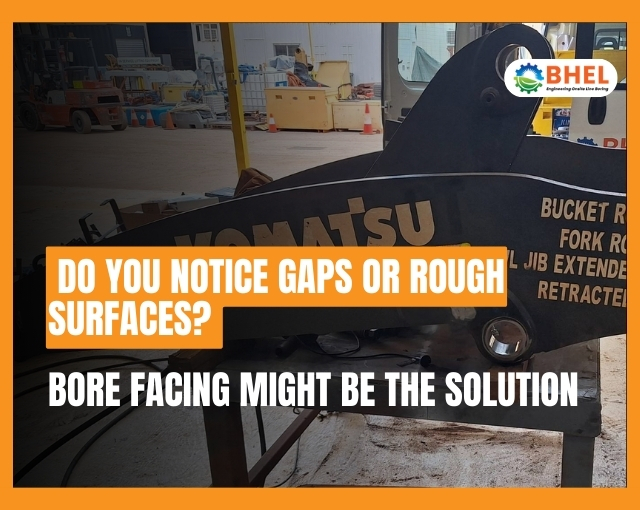
Small gaps, uneven contact surfaces, and rough finishes in areas where parts should fit perfectly.
These issues often start quietly but can lead to major machinery failure if ignored.
In many industrial environments, these problems point to worn or damaged bores. Bore facing is a precise machining solution designed to restore flatness, alignment, and proper contact surfaces, without replacing the entire component.
At BHEL Engineering, we regularly see equipment that appears “mostly fine” but hides surface damage that slowly reduces performance. This guide explains when bore facing is the right solution, how it works, and why acting early saves time and money.
What Are Gaps and Rough Surfaces Telling You?
Gaps and rough surfaces are warning signs. They often mean the bore face has:
- Worn unevenly over time
- Been damaged by vibration or load stress
- Suffered corrosion or impact damage
These surface imperfections prevent proper seating of bearings, bushes, or mating components.
Ignoring them usually leads to:
- Misalignment
- Accelerated wear
- Increased vibration
- Premature component failure
What Is Bore Facing?
Bore facing is a precision machining process used to restore the flat, square surface at the end of a bore. It ensures that components sit flush and align correctly during operation.
Unlike general machining, bore facing focuses specifically on:
- Correcting surface irregularities
- Restoring perpendicular alignment
- Improving load distribution
It is commonly used in housings, pivot points, and heavy equipment components.
When Should You Consider Bore Facing?
1. Visible Gaps Between Components
If you notice gaps where parts should sit tightly together, bore facing can restore the contact surface.
Even small gaps can cause:
- Load concentration
- Component movement
- Premature fatigue
2. Rough or Uneven Surface Finish
Rough surfaces increase friction and prevent proper seating.
Bore facing creates a smooth, even finish that:
- Improves component fit
- Reduces vibration
- Supports consistent load transfer
3. Repeated Bearing or Bush Failures
Frequent replacements often signal a surface alignment issue, not a part quality issue.
In many cases, bore facing corrects the root cause rather than treating the symptom.
How Bore Facing Restores Machinery Performance
Precision Surface Restoration
Bore facing removes minimal material while restoring accuracy. This helps retain original component strength.
The result:
- Correct surface geometry
- Improved mating contact
- Longer component life
Improved Alignment and Stability
A flat bore face ensures bearings and bushes align correctly with shafts and pins.
This reduces:
- Side loading
- Vibration
- Uneven wear patterns
Real-World Insight from BHEL Engineering
In real repair situations, we often find that equipment owners consider replacing housings or large components due to repeated failures. After inspection, the root cause is frequently a worn or damaged bore face.
By applying bore facing at the right time, machines return to stable operation without unnecessary replacement costs.
Bore Facing vs Full Component Replacement
Why Replacement Isn’t Always Necessary
Replacing a full component can be:
- Costly
- Time-consuming
- Logistically challenging
Bore facing allows targeted restoration, preserving most of the original part.
Faster Turnaround
Bore facing repairs typically:
- Reduce downtime
- Avoid long lead times
- Minimise disassembly
This makes it an efficient solution for critical equipment.
Common Causes of Bore Face Damage
Understanding the cause helps prevent recurrence:
- Misalignment during assembly
- Overloading
- Poor lubrication
- Long-term vibration
- Corrosion exposure
Addressing these factors alongside bore facing improves long-term reliability.
Bore Facing as Part of Preventive Maintenance
Including bore facing during scheduled maintenance:
- Prevents unexpected failures
- Extends service intervals
- Improves overall equipment reliability
According to industrial maintenance best practices, surface accuracy plays a major role in asset longevity.
Precision surface restoration is also widely recognised in reliability engineering standards.
Key Takeaways / Summary
If you’re noticing gaps or rough surfaces, bore facing may be the precise solution your machinery needs.
Key Takeaways:
- Gaps and rough surfaces signal alignment issues
- Bore facing restores flatness and accuracy
- Early repair prevents repeated failures
- Targeted restoration avoids full replacement
If you’re seeing gaps, rough surfaces, or repeated component failures, BHEL Engineering can assess whether bore facing is the right solution. Get in touch with our team to restore accuracy and reliability before minor issues become major problems.