
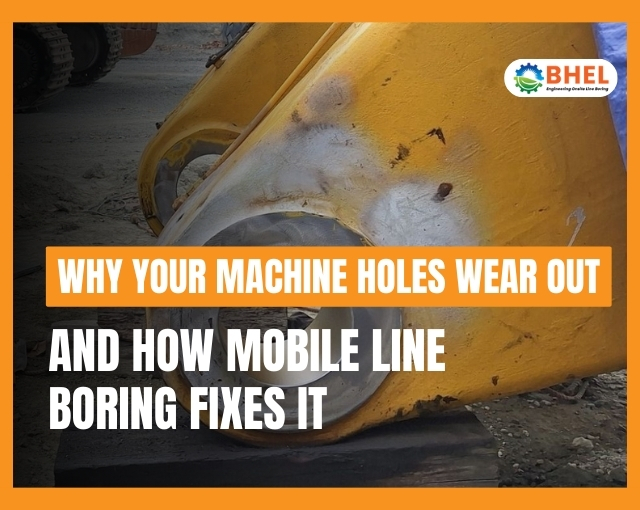
Machine holes play a critical role in keeping your equipment strong, aligned, and safe. These holes hold pins, shafts, bushes, and bearings in place. When they wear out, everything connected to them begins to suffer.
Worn holes may look like a small issue at first, but they can quickly cause misalignment, vibration, breakdowns, and safety risks. This is where mobile line boring becomes one of the most effective repair solutions.
At BHEL Engineering, we regularly restore worn and damaged holes on heavy machinery using mobile line boring, allowing equipment to return to proper working condition without expensive replacements or long downtime.
What Does It Mean When Machine Holes Wear Out?
Machine holes wear out when their original round shape becomes:
- Oval
- Enlarged
- Uneven
- Misaligned
This usually happens slowly due to repeated movement, heavy loads, vibration, and lack of lubrication.
Once a hole loses its shape, the pin or shaft no longer fits tightly. This causes:
- Extra movement
- Increased stress
- Faster wear on nearby parts
Ignoring this problem almost always leads to bigger mechanical failures.
Common Reasons Machine Holes Wear Out
1. Constant Load and Pressure
Heavy equipment carries high loads every day. Over time, this pressure slowly deforms the hole surface.
2. Lack of Proper Lubrication
Without lubrication, metal rubs against metal. This friction accelerates wear dramatically.
3. Misalignment
When pins and shafts are not perfectly aligned, they rub unevenly against the hole walls, causing oval-shaped damage.
4. Dirt and Contamination
Dust, metal particles, and moisture act like sandpaper inside holes and bushes, increasing wear.
5. Vibration and Shock Loads
Sudden impacts or constant vibration weaken the structure around the hole.
Why Worn Machine Holes Are a Serious Problem
When holes wear out, machines begin to:
- Lose precision
- Become unsafe
- Require frequent repairs
- Develop structural fatigue
Small movement inside a worn hole grows into:
- Broken pins
- Cracked housings
- Costly shutdowns
Early repair is always cheaper and safer.
What Is Mobile Line Boring?
Mobile line boring is a precision machining process used to repair worn or damaged holes directly on-site. Instead of removing and replacing heavy components, the boring equipment is brought to the machine.
This process:
- Restores the hole to its correct size
- Realigns it perfectly with other holes
- Allows the installation of new bushes or pins
It is one of the most efficient ways to repair worn machine holes without major disassembly.
How Mobile Line Boring Fixes Worn Machine Holes
1. Restores Perfect Alignment
Mobile line boring machines are set up using precision measuring tools. This ensures all repaired holes line up exactly as designed.
Correct alignment means:
- Smooth operation
- Less vibration
- Longer equipment life
2. Brings Back the Correct Size and Shape
The worn hole is machined back to a perfect round shape. This allows:
- Tight-fitting bushes
- Secure pins
- Proper load transfer
3. Strengthens the Repair
After boring, a new bush or sleeve is often installed. This gives the hole a strong wear surface, often better than the original.
4. Reduces Downtime
Because repairs are done on-site:
- Transport is avoided
- Large dismantling is unnecessary
- Machines return to work faster
Real-World Insight from BHEL Engineering
In real operations, we often see machines that have gone through repeated pin replacements without solving the actual issue. The problem is usually not the pin it is the worn hole.
Once mobile line boring is applied, those repeat failures stop. The machine runs smoother, maintenance becomes predictable, and overall performance improves.
This is why mobile line boring is not just a repair method. It is a long-term reliability solution.
Mobile Line Boring vs Replacing Components
Replacing large components like frames or arms can be:
- Extremely expensive
- Time-consuming
- Logistically difficult
Mobile line boring allows:
- Precision repair
- Lower costs
- Faster turnaround
- Preservation of original structure
In many cases, it is the smarter and safer option.
When Should You Consider Mobile Line Boring?
You should consider mobile line boring if you notice:
- Excess movement in pins
- Oval-shaped holes
- Frequent bush failures
- Noise or vibration from pivot points
- Cracks near hole areas
Early action prevents structural damage.
Mobile Line Boring and Preventive Maintenance
Adding mobile line boring into your maintenance strategy:
- Extends machine life
- Reduces breakdown risk
- Improves safety
- Lowers total repair costs
Conclusion
Worn machine holes should never be ignored. Mobile line boring provides a precise and efficient way to restore performance without replacement.
Key Takeaways:
- Worn holes cause misalignment and breakdowns
- Mobile line boring restores shape and strength
- On-site repairs reduce downtime
- Early action prevents costly failures
If your machine holes show signs of wear, movement, or misalignment, BHEL Engineering can restore them with professional mobile line boring solutions. Contact our team today to protect your equipment and avoid costly breakdowns.